Does power corrupt?
The Epstein List, Venice, and Mother Nature

TLDR: Medieval rich kids shot arrows into church ceilings because economic dependence = impunity. A saint tried to give away her wealth to the poor instead of marrying rich. This month, the Epstein files dropped 3 million pages showing what billionaires choose when they have every choice. The upper class needs you to believe “anyone would do this” so you’ll normalize their abuse. Spoiler: not everyone does.
The Epstein files dropped this month. Over 3 million pages. Billionaires begging for loans while forwarding government secrets. Private island visits. “Bring your harem!” Wealth built on debt and illusion. And underneath it all: the sexual exploitation of vulnerable people.
All the money in the world. All the choices. And this is what they chose.
This traumatic account seems evidence of the mantra “power corrupts.” I have been mulling over that statement quite a lot in the last few months, and I have to say…I’m starting to not agree.
Just a few months ago in Italy, I saw that for centuries, some people with power shoot arrows at people who can’t fight back and some people with power try to give their wealth away.
And we’ve been told that only one of these is “human nature.”
We chose to go to Bologna for the food, so we did not know that it is home to the oldest running university in the world (after our trip to Egypt, I would have thought it would be in the Middle East…perhaps “running” is the key word there).
The university building was not built in its first 500 years because it operated by teachers renting rooms out of their homes where students lived. Students had contracts with the teachers where they agreed on what they wanted to learn. Consequently, this university was very independent. Also consequently, the pope didn’t love it. Especially during counter-reformations.
In 1563, the clergy of Rome wanted to put a stop to protests, so Bolognese citizens and students had to be heavily controlled. Thus, university buildings were built so the Pope could control people in one place. As the powerful often do, they offered something enticing for the people in return for control…a beautiful environment to study in exchange for centralizing them in one place.
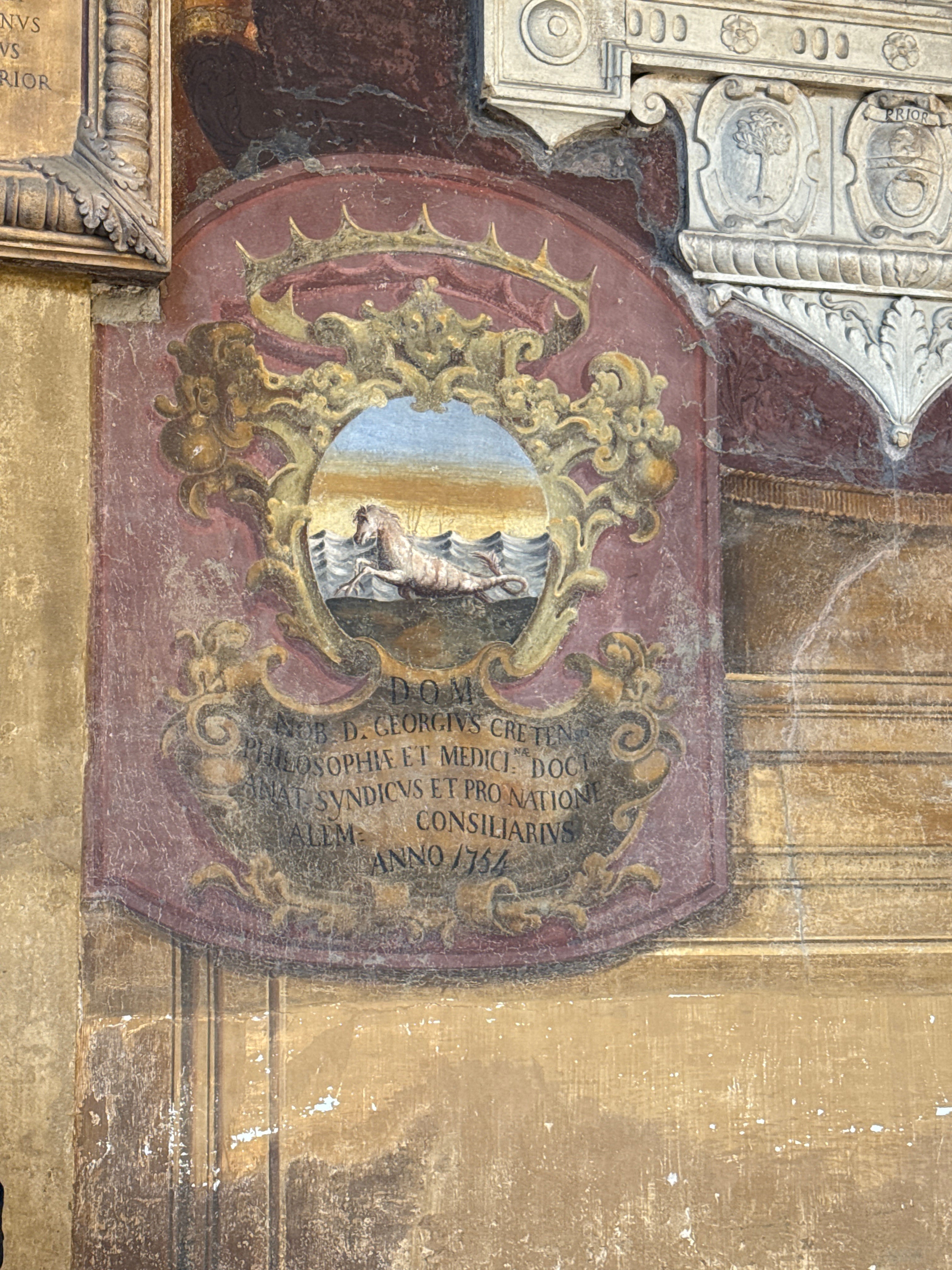
In addition to papal power, there are also signs of another abuse of power throughout the city — rich brat power.
Bologna’s sidewalks are mostly covered by upper stories. According to our walking tour guide, this is because of a tax exemption. People are only taxed on their houses that touch the ground, so an above-ground space that leaves a sidewalk beneath is cheaper. Again, in exchange, this city has pleasant walking and cafe chair space regardless of weather, shielding people from rain and too much sun.
As we stood under one of these protected sidewalks, the guide pointed out an arrow was sticking out from one of them (can you spot it?).

This arrow is one remaining from the wealthy students who would pull pranks on locals by shooting arrows into their homes. Apparently, this was quite common. Bolognans put up with it because they had an economic dependence on the students. If they came down too hard on the rich students, they could lose their livelihoods, which revolved around the school. This is what happens when people with resources know you can’t afford to hold them accountable.
So far, it would seem that power does, in fact, corrupt, no?
The Saint Who Refused
Another cool thing about Bologna is that it’s pretty easy to get around to several Italian cities by train. Honey and I hopped on a train to Venice one day just cuz.
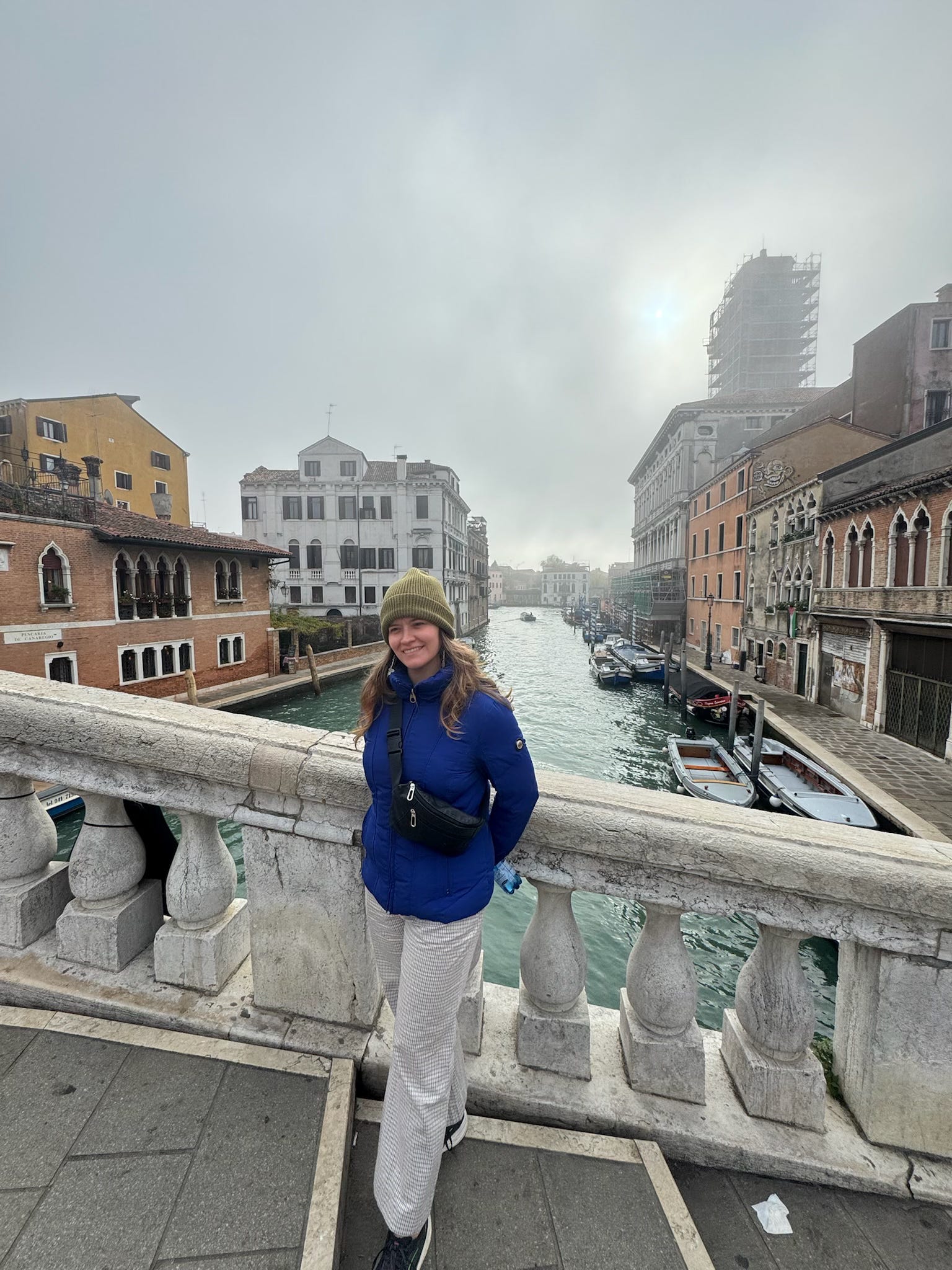
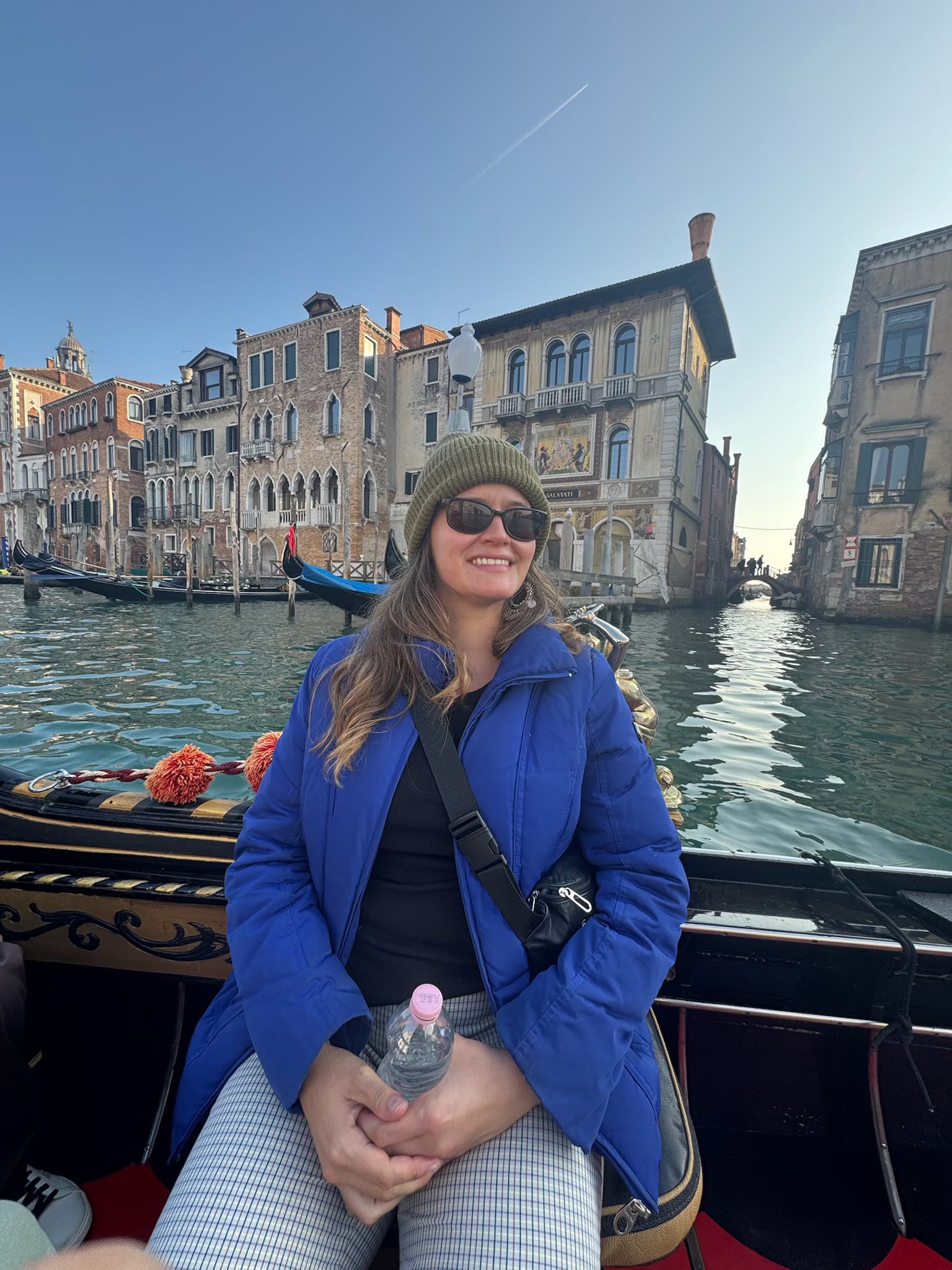
We didn’t have any plans, but of course that indelible Catholic mark on my soul navigated me to a church and we popped in. I was surprised to find that it had the entire body of St. Lucy laid out. A full-body relic.

Saint Lucy of Syracuse. Born to a wealthy Roman family around 283 AD. Her father died when she was five, leaving her and her mother without a “protective guardian”—which in ancient Rome meant vulnerable despite their wealth.
Lucy had already decided to consecrate her virginity to God and wanted to distribute her dowry to the poor. Her mother, not knowing this, and suffering from illness, arranged Lucy’s marriage to a young man from a wealthy pagan family.
After her mother was cured on a pilgrimage to Saint Agatha’s shrine, Lucy convinced her mother to let her give away her wealth to the poor instead of getting married.
Her wealthy pagan fiancé, furious that the money was being distributed rather than coming to him through marriage, denounced her as a Christian to the Roman governor.
The governor ordered her to burn a sacrifice to the Roman gods. She refused. He sentenced her to be defiled in a brothel. According to legend, she became immovable—guards couldn’t drag her, even with oxen. So they tried to burn her alive. When that failed, she was finally killed by a sword to the throat.
Let me be clear about what happened here: Lucy had wealth. She had security. She had the option to marry into even more wealth and power. She had the choice to play it safe, to be “practical,” to do what any “reasonable person” would do.
She chose to give it away instead.
And they killed her for it.
The Pope and the wealthy Bologna students were both fighting over power—economic leverage versus institutional control. St. Lucy made a different choice: she used her wealth and autonomy while she had it, before the system could take it from her through marriage. But we’re only told one is “natural.”
The Lie About Nature
I’ve been spending a lot of time in jungles and forests over the past month (not in Italy, you’ll learn where in future posts). And something I keep noticing—something I’d forgotten from years of being stuck in cities and offices—is how symbiotic nature actually is.
Roots grow around rocks. Trees and ferns and moss rely on each other and aren’t threats to each other. They need each other to survive.
This is so different from what we’re told is “just natural”—which is stepping on other people to get more.
Yes, leaves compete for sunlight. But they don’t do that by taking ALL the sun. Trees share resources through mycorrhizal networks—underground fungal highways connecting root systems. When a Douglas fir gets injured by insects, it sends chemical warning signals through the network to ponderosa pines nearby. The pine then produces defense enzymes to protect itself.
Mother trees—the oldest, most connected trees in a forest—detect distress signals from younger trees and send them nutrients through these fungal networks. Saplings growing in deep shade, without enough sunlight for photosynthesis, survive by receiving sugar and nutrients from older trees through the mycorrhiza.
The fungus takes about 30% of the sugar the trees produce as payment for its delivery services. Everyone benefits.
Now—is nature ONLY cooperation? No. That would be dishonest.
Black walnut trees produce juglone, a chemical that inhibits the growth of many plant species around them, reducing competition. Some invasive plants succeed through allelopathy—releasing toxic chemicals into the soil to kill off native species that haven't evolved defenses against them. Male bowerbirds steal decorations from each other's mating structures. Red deer males and females live separately for most of the year, since they have different nutritional needs, only meeting up during mating season.
But here’s what’s critical: even the competitive examples aren’t about total domination or hoarding ALL resources. They’re about securing enough. About survival.
The black walnut doesn’t kill every plant in the forest. The red deer doesn’t prevent all other deer from eating ever. Invasive plants that DO try total domination often destabilize entire ecosystems—including their own survival.
What’s NOT natural is the kind of resource hoarding we see in modern wealth accumulation. Taking so much that others can’t survive. Building bunkers while people starve. Trafficking children.
That’s not competition. That’s pathology.
And I think we’ve been sold this lie—that unbounded greed is “just natural”—because it justifies corruption. It normalizes insane, ungodly amounts of wealth and power. When someone with billions does something harmful, there’s always someone in my comments saying “We’d all do it if we could.” It’s just “human nature.”
No. It’s not.
The Classist, Patriarchal Editing of Evolution: The Same Pattern, Centuries Later
What we have permitted to be studied and the lens we have studied through, is largely shaped by our systems…which have been shaped by who holds the power.
For example, The University of Bologna was granted special status in 1292 by Pope Nicolas II—any student graduating in medicine there could teach anywhere in the world. But that papal generosity came with strings attached.
From 1315 onward, when Mondino de Liuzzi performed the first officially sanctioned human dissection in Bologna since ancient Greece, the Church didn’t just allow dissection—it controlled every aspect of it.
Public dissections were permitted once or twice a year. Only on bodies of executed criminals—both male and female—provided by local authorities. The sessions were strictly standardized: three men with clearly defined roles. The Lector (lecturer) read from authoritative texts—usually Galen’s work on anatomy. The Ostensor pointed to the body part to be discussed. The Sector (a barber surgeon) actually performed the cutting.
The anatomist never touched the body. He sat elevated, reading from ancient texts, while a surgeon did the actual dissection below.
This wasn’t about learning from what you could see in front of you. This was about confirming what ancient authorities had already written.
And the Church controlled more than the format. They controlled which bodies: initially only male cadavers could be dissected. Female bodies were added later—by papal permission (And we’re STILL dealing with the consequences of women and people of color being excluded from medicine: modern medicine’s massive research gap on women’s health, which is a major reason why women are underdiagnosed, more susceptible to disease than men, and are more likely to die from many conditions. As of 2020, only about 10% of NIH funding went to women’s health (and that was pre-DOGE cuts people.).
Further, Bolognan physicians didn’t just need medical knowledge. They needed PhDs to defend their scientific work against clergy who considered anatomy morally suspect.
The pattern is clear. The Church controlled:
Which bodies could be studied (male first, female only by papal permission)
How often you could study them (once or twice a year)
Who could do the studying (only those who could defend it theologically)
What you were allowed to conclude (nothing that threatened Church doctrine)
The same pattern the Bologna Pope used to control anatomical studies in the 1500s was still operating in American biology departments in the 1970s.
Lynn Margulis, an American biologist, proposed the endosymbiotic theory—that complex cells (eukaryotes) didn’t evolve through competition and domination, but through symbiotic merger. Mitochondria and chloroplasts, the powerhouses of our cells, were once free-living bacteria that merged with other cells in mutually beneficial relationships.
When she published this in 1970, she was dismissed as radical. Her ideas about symbiosis—cooperation, mutual benefit, interdependence—were “greeted with skepticism and even hostility.”
Why? Because symbiosis didn’t fit the “survival of the fittest” story we’ve been force-fed.
It took decades for the scientific community to accept what’s now considered fundamental biology: cooperation, not just competition, drives evolution.
For a great TikTok on her, see: https://www.tiktok.com/t/ZThPedTGp/
Think about what that means:
In the 1500s, the highest echelons of male clergy controlled which bodies could be studied and what conclusions were acceptable about anatomy
In the 1970s, elite male-dominated science departments controlled which theories about nature were “acceptable” and which were “radical”
Both systems elevated competition and dominance while suppressing or dismissing cooperation and interdependence
Both required scientists to defend their work in terms that wouldn’t threaten the prevailing power structure
The Pope made physicians learn philosophy to defend anatomy. The scientific establishment made Margulis defend symbiosis against “survival of the fittest” orthodoxy for decades.
Same pattern. Different century. Same elite power systems doing the gatekeeping.
They taught us about competition and survival of the fittest. They didn’t teach us that the very cells in our body exist because of ancient cooperative mergers. That symbiosis is as fundamental to life as competition.
They edited out the cooperation and called it “science.”
That’s patriarchy and classism at work. Not just in how we treat people, but in how we understand the entire natural world. In what we’re allowed to study, whose bodies matter, and what conclusions we’re permitted to draw about nature itself.
And this matters because it also normalizes a really toxic idea that I have to work on constantly with my clients: the belief that anyone with power and influence is bad.
We’ve conflated power with abuse so thoroughly that we can’t imagine one without the other. We’ve aligned bad behavior with “leadership skills” and “risk management” and “making tough decisions”—while children starve, parents have no support, and the planet literally is struggling to sustain us.
When Powerlessness Seeks Dominance
But there’s another pattern worth examining: what happens when patriarchy promises you power that class denies you?
First, let’s be clear: patriarchy is a system, not a gender. It’s a pyramid—a few at the top, everyone else fighting to get there. You can have a woman CEO and it’s still patriarchal if the structure rewards dominance over others. A matriarchy isn’t “patriarchy with women on top”—it’s a completely different system, a circle focused on harmony and balance rather than hierarchy and control. Any gender can perpetuate patriarchy.
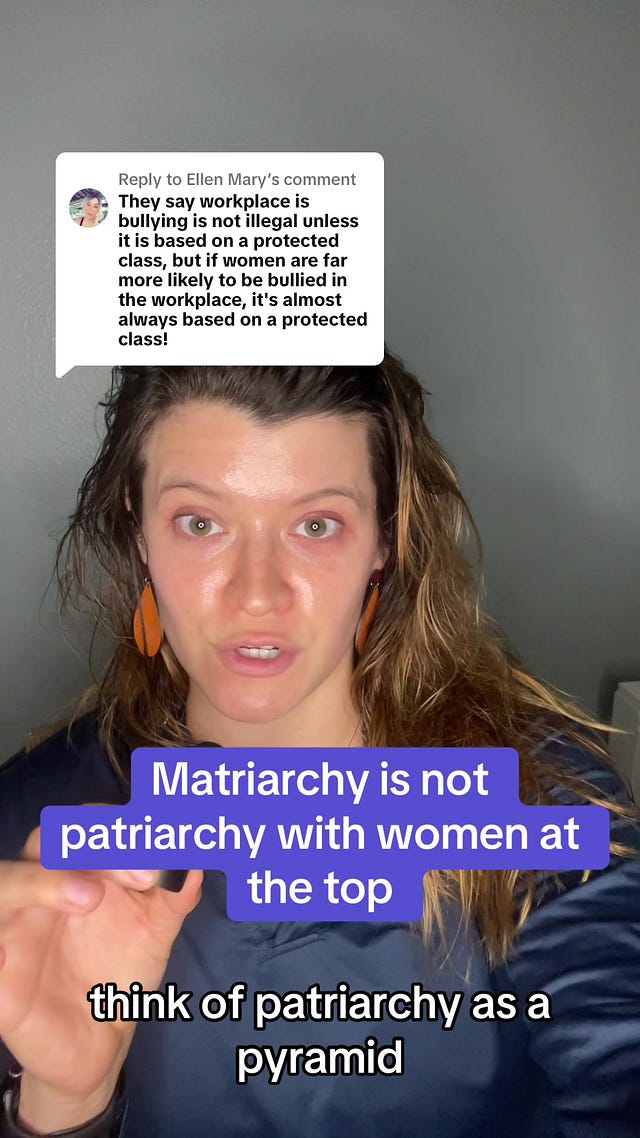
 Tiktok failed to load.
Enable 3rd party cookies or use another browser
While most people in power are men, most men are not in power.
Patriarchy tells men their value comes from dominance. But capitalism only delivers the resources for that dominance to a very few men at the top. The rest get the message without the means.
But what about men who get the patriarchal script—"real men dominate”—without the class position to back it up?
They make up extra rules.
I noticed this in Egypt, when Honey and I were traveling with a group from his elite master’s program. I noticed these wealthy international men sit with legs crossed, hands resting delicately on their knees. In the rural American South where I’m from, that posture would be called “fruity,” “gay,” “not manly.” Honey was surprised; that would have never occurred to him as not masculine (and he’s Albanian, okay? They’re not exactly known for “soft” men).
Because when you don’t have financial power, you need other ways to prove you’re a “real man.” So you add rules: Don’t cross your legs. Take up space. Don’t show emotion. Don’t do “women’s work.” Police your body constantly.
But men with actual wealth and resources? They can bend some of those rules. They don’t need to perform masculinity through manspreading because they have other, more tangible forms of power. Money buys you flexibility in how you perform gender.

This is the overlap between patriarchy and classism:
Upper-class men: Get to define what “leadership” and “success” look like (often: their own behavior). Can break minor gender rules because their class position is secure. Can abuse power through “legitimate” channels—corporate exploitation, legal tax evasion, political influence.
Working-class men: Told they should have dominance but lack the resources to achieve it through “legitimate” means. Compensate by rigidly policing masculinity rules. When traditional avenues for feeling powerful close (fewer women partnering, manufacturing jobs gone, unions broken), some look for other targets to dominate.
And here’s where certain jobs become attractive: positions that offer legal authority over vulnerable people. My mom works in corrections, so I’m not painting with a broad brush—but we know some fields (such as law enforcement) attract higher rates of domestic abuse for a reason. When you’re told your value comes from dominance, and you don’t have economic power to demonstrate it, you look for something weaker than you to tell you that you’re big. Rounding up families. Separating children from parents. Finally, being the one with power, the one who can make people afraid, the one who matters.
The deflection is always the same from the wealthy elite:
“I would pay you a living wage and give you healthcare, but I can’t because I have to exploit the immigrants. So if you go round them up and that makes you feel like a big man, when you get back I’ll pay you decently.” (While also telling everyone they’ll be replaced by AI.)
This is patriarchy and classism working together:
Promise working-class men that dominance equals masculinity
Deny them the economic resources that typically buy dominance
Offer them a target (immigrants, women, children) to dominate instead
Reward them with just enough—a badge, a sense of importance, maybe slightly better pay than the people they’re rounding up
Meanwhile, the men who actually have resources (the Epstein associates) face no consequences for exponentially worse behavior
Working-class white men are especially vulnerable to this because they get a triple message:
Patriarchy says you should dominate
White supremacy says you should dominate
Class reality says you can’t afford to, so they’re pissed
You’re told you should have power because you’re a man and you’re white. You see other men who look like you with massive amounts of power. But you’re not one of them. You’re told it’s your birthright, but you don’t have it.
So when someone offers you a uniform and a target—someone more vulnerable than you, someone you CAN dominate—it feels like finally getting what you were promised.
And spare me the “but immigrants and crime” deflection. If we really cared about crime, we’d be rabidly dethroning everyone on the Epstein list. We’d talk about all the white-collar crime in massive organizations—wage theft, tax evasion, environmental destruction, financial fraud.
But we’re really picking and choosing which harms matter, aren’t we? We’re focusing on the ones that let certain people feel powerful while ignoring the ones committed by people who already are.
This is how class and patriarchy work together to protect the actually powerful:
Keep working-class men focused on feeling bigger than women and immigrants instead of the bosses who won’t pay them. Promise them dominance through gender instead of through economic security. Give them targets below them on the hierarchy instead of solidarity across it.
Meanwhile, people with actual resources—the ones on the Epstein list, the ones running the corporations, the ones making the decisions—face no accountability. They get to abuse power through “legitimate” channels: hostile takeovers, mass layoffs, environmental destruction, financial manipulation.
And when their abuse becomes undeniable? They hire lawyers, settle out of court, move to another company, get appointed to government positions. They’re evaluated by the systems they’ve put in place, judges they went to Yale with, and friends from private school. White-collar crime is almost always disproportionately more harmful, but it is not punished nearly as much as petty theft and marijuana charges.
White-collar crime doesn’t get the same attention as other crimes because the people with white-collars are the ones making the decisions.
The Bologna students shot arrows and faced no consequences because of economic dependence.
Working-class men today are offered badges and the legal authority to round up families—given just enough power to feel like they matter, never enough to actually threaten the hierarchy.
And the men at the very top? They build bunkers, visit private islands, exchange millions in “loans” while playing “Buy, Borrow, Die” with multiple properties, and when the files drop, they claim everyone would do the same.
Three different class positions. Same patriarchal promise of dominance. Wildly different consequences for abuse.”
Elon Musk discussing visits to Epstein’s island. Donald Trump. Bill Clinton. The Andrew formerly known as Prince Andrew. Steve Bannon exchanging “hundreds of friendly texts” with Epstein months before his arrest. Richard Branson inviting Epstein to his private island—"As long as you bring your harem!” Tech billionaires. Former Israeli Prime Ministers. Trump’s Commerce Secretary Howard Lutnick, who visited the island with his family despite claiming he’d cut ties decades ago. Wall Street titans. Nobel Prize winners.
All the money in the world. All the power. All the choices. And this is what they chose.
But here’s what else the files revealed: wealth itself is often a game of appearances, built on extensive borrowing and smoke and mirrors.
Sarah Ferguson, Duchess of York, was £4 million in debt despite her royal connections. In 2009, she begged Epstein: “I urgently need 20,000 pounds for rent today. The landlord has threatened to go to the newspapers if I don’t pay. Any brainwaves?” Two years later, she accepted another £15,000 loan to pay back staff.
Peter Mandelson, the Labour peer who should have had the means and connections to manage money, borrowed £75,000 from Epstein. His then-partner received £10,000 for an osteopathy course he never completed. Mandelson was forwarding confidential government information to Epstein while discussing schemes to purchase a £2 million apartment in Rio through a Panama shell company for tax avoidance.
If he needed to borrow £75,000, where would that £2 million have come from? And in return for what currency of favor?
This is how it works at the top: billionaires often carry the most debt. They use complex borrowing strategies called “Buy, Borrow, Die”—never spend capital or profits, constantly borrow against appreciating assets, take out new loans to pay off old loans, and when you die, your heirs avoid capital gains tax entirely.
Houses, cars, yachts, parties, even charitable donations—all paid for by debt. All designed to create the illusion of wealth. All available to lease, rent by the hour for Instagram, or simply steal (as debt-ridden socialite David Tang did, transferring company funds to his private account).
Epstein specialized in these schemes. He was the specialist lender, the private banker, the financial Svengali who could make the wealth illusion tricks work—for a price.
They want you to believe that “anyone would do this if they had the chance.” That this is just what happens when you have resources. Human nature. That’s just what powerful men do.
I don’t believe that.
The Question
Does power corrupt everyone, or is that just the lie the powerful tell us to normalize their behavior?
The wealthy students had freedom—and used it to shoot arrows at people who couldn’t fight back.
The Pope took control—and decided what could be studied, by whom, and what conclusions were acceptable.
The men in the Epstein files had every resource—and chose to abuse vulnerable people.
St. Lucy had wealth and security—and tried to redistribute it.
Four different responses to power. Only one DOESN’T get called “human nature.”
The normalization is the weapon. If “anyone would do it,” we normalize exploitation, stop expecting better, and turn on each other instead of them.
Women uphold patriarchy too. Wealthy women enable powerful men’s access to vulnerable people. They gatekeep who belongs in elite spaces. They police other women who step out of line. The Epstein files include women’s names. Ghislaine Maxwell wasn’t an aberration—she was operating within a system that rewards certain women for protecting powerful men’s access to harm. Just because a woman’s doing it doesn’t mean it’s not patriarchal. Ironically, women are more likely to be punished. Ghislaine Maxwell is the only person in prison for these atrocities. I’m not saying she should be out—but those prisons should be a lot fuller.
The elites need us to believe exploitation is natural, inevitable—not cultural rules they created to benefit themselves. If you believe everyone would shoot the arrows, you’ll tolerate the people who do. If you believe that’s just “how men are,” you’ll accept abuse. If you believe “that’s just business,” you won’t organize.
Except it’s not natural. Power doesn’t corrupt everyone.
Some people with power shoot arrows, build bunkers, hoard wealth, exploit workers, control knowledge, and call it “natural” or “efficient.”
Others try to redistribute, build support systems, protect the vulnerable, refuse cycles of abuse, share knowledge, create access.
St. Lucy chose to refuse the entire system—even unto death. That kind of story is dangerous. It suggests people with power can choose differently.
The Arrows Are Still There
The arrows are still in the ceiling in Bologna. St. Lucy’s relics are still in Venice. The students who shot them are long dead.
But we still tell ourselves their lie: that people with power will always abuse it. That expecting better is naive.
I’m watching America from Italy—the wealth gap, the violence, the billionaire bunkers—and I keep thinking: whose stories are we telling, and who benefits from us believing corruption is inevitable?
Because as long as we believe everyone would shoot the arrows, we tolerate the people who do. As long as we believe hoarding is human nature, we won’t demand redistribution. As long as we believe abuse of power is inevitable, we won’t hold the powerful accountable.
That’s exactly what they need us to believe.
What This Means for Work
This is toxic individualism at scale. Workplaces tell you “we’re all family” until you’re not useful, “everyone’s replaceable” so don’t organize, “that’s just business” so accept exploitation.
Leaders fear psychological safety because if people realize they can challenge power, they might. Organizing is “troublemaking” but union-busting is “good management.” Speaking up is “not being a team player.”
Because the arrow-shooters need you to believe everyone would shoot arrows. That people like St. Lucy are naive.
But here’s what research shows: Some people want to shoot arrows; most of us don’t. But the problem is we reward people who do. We put them in leadership positions, perpetuating the lie that it is normal. It becomes a self-fulfilling prophecy.
And the moment we stop believing that lie, the arrows stop flying.
Getting Different People Into Power
My entire business exists because of this realization: if we want different outcomes, we need different people making decisions.
Not just “diverse” in the way companies mean it (check a box, add a photo to the website). Different in values. Different in what they believe power is for.
My mission is to identify and reduce invisible barriers to social class mobility in the workforce. To help first-generation professionals and neurodivergent leaders navigate office politics without losing their authenticity. To get people into decision-making positions who won’t pull the ladder up behind them.
Because right now? The people who succeed in most workplaces are the ones who most easily perform “normal”—which means upper-middle-class, neurotypical, white cultural scripts. The people who already knew the unwritten rules because they grew up watching them.
The people who question those norms? Who push back on exploitation? Who refuse to participate in the arrow-shooting? They get labeled “not a culture fit.” “Not ready for leadership.” “Too aggressive” or “not assertive enough” depending on their identity.
We’re selecting for arrow-shooters and calling it meritocracy.
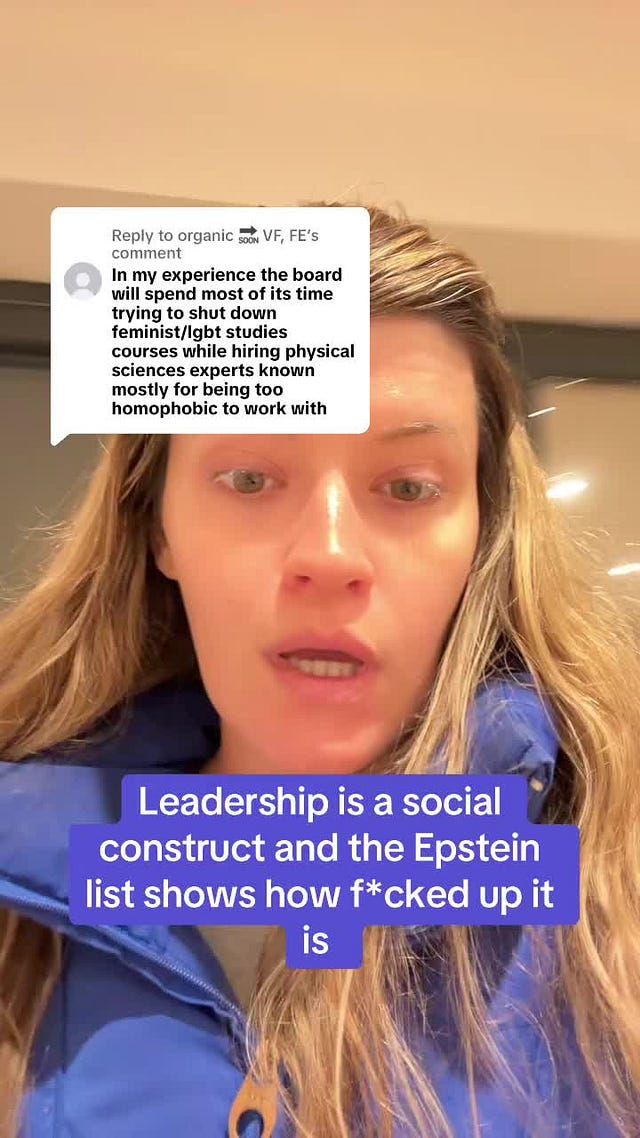 Tiktok failed to load.
Enable 3rd party cookies or use another browser
The Bologna students had freedom and used it to terrorize people. The Pope took that freedom and used it to control knowledge. St. Lucy had power and tried to redistribute it. The system killed her for it.
We need more people in power who think like Lucy, not like the arrow-shooters or the gatekeepers.
That’s what I’m trying to build: a path for people who give a fuck about others, who believe in learning and accountability, who have the courage to do what’s right even when it’s not trendy. People who understand that profit, people, and community are symbiotic—not interchangeable.
Because the lie isn’t just that “power corrupts everyone.” The lie is also that “the people in power earned it through merit.”
They didn’t. They learned the right cultural scripts. They shot the right arrows at acceptable targets. They defended the right gatekeepers. They performed “normal” well enough that no one questioned whether they should be there.
Breaking that pattern means naming it. Understanding it. And refusing to perpetuate it—even when conforming would be easier. And we have to stop falling for the lies of charismatic people who fit our stereotypes of what leadership is. Because clearly, it is warped.

Yes! Lucy and Lynn Margulis. 🙂
Hi Dr, Kallsmchidt, I noticed your youtube is gone. I hope it was personal decision and not something done by youtube. I enjoyed watching your videos.